
One of the Most Volatile Local Issues of Our Time May Be Coming Your Way
….heads up, folks. This is a huge issue brewing border to border in Iowa

Local, Local, Local —Two Things Can Be True
I am fascinated by artificial intelligence. It helps me organize information, sort through mountains of material, summarize documents, brainstorm ideas, and occasionally rescue me from my own technological shortcomings.
I have little doubt AI will transform medicine, agriculture, education, transportation, manufacturing, scientific research, and journalism. It is already changing the way many of us work.
Artificial intelligence is not going away.
Nor should it.
Trying to stop AI would be like trying to stop the internet in the 1990s.
But another thing can also be true.
Taxpayers should no longer be expected to foot the bill.
And environmental protection must be an essential part of all of it.
Iowa is one of the states that has offered incentives such as tax abatements and other benefits to attract data centers.
Why?
That question came to mind after reading Cheryl Tevis’ thoughtful reporting this week on the issue. If you do not yet subscribe to Cheryl’s column, I highly recommend that you do. Cheryl and her husband farm in Boone County. She spent much of her career writing for Successful Farming magazine, and I am delighted she chose to join the Iowa Writers’ Collaborative.
Her reporting last week got me thinking about many of the questions raised here.
Across Iowa, communities are being told that data centers represent the future. They bring investment, attract technology companies, and position Iowa for a digital economy that is expanding at breathtaking speed.
All of that may be true.
But these facilities are also extraordinarily water- and energy-hungry. They place demands on electrical grids, transmission systems, roads, water supplies, and public infrastructure. Increasingly, they are being built by some of the wealthiest corporations in human history—and given tax breaks to do so.
This isn’t a hypothetical discussion.
Iowa has already provided substantial incentives to attract data centers operated by Google in Council Bluffs, Microsoft in West Des Moines, Meta in Altoona, and Apple in Waukee. Supporters point to billions of dollars in investment and thousands of construction jobs.
There are cases where it makes sense to incentivize business to build in Iowa. And, there are cases where it does not.
Many of these facilities employ relatively small numbers of permanent workers once construction is complete. Yet the tax incentives, infrastructure demands, and resource consumption remain.
That raises a reasonable question.
Why are taxpayers subsidizing them?
I understand the argument made by lobbyists for the beneficiaries, if Iowa doesn’t offer incentives, another state will.
Perhaps. But citizens across the country are starting to pay attention. And writing about it. And showing up. And demanding to be represented.
At some point utility customers, taxpayers, and neighbors have a right to ask a simple question:
What is the total cost, environmentally and financially?
For years, Iowans have been told there isn’t enough money for water quality, conservation, aging infrastructure, schools, mental health services, or rural healthcare. Yet somehow, when another data center comes calling, we discover millions of dollars in tax incentives.
That strikes me as worthy of discussion.
The debate too often becomes a false choice.
Either you support artificial intelligence and data centers, or you support the environment.
Either you support economic growth, or you support clean water.
Either you support innovation, or you support responsible stewardship.
I reject that premise.
Two things can be true.
We need AI. We need clean water.
And taxpayers should stop subsidizing it.
We can welcome data centers while expecting the companies that profit from them to help pay for the infrastructure they require. We can embrace innovation while insisting on transparency. We can support economic development while protecting natural resources.
In fact, that’s exactly what responsible public policy should do.
If a data center requires expanded transmission lines and consumes enormous quantities of water, shouldn’t the companies benefiting from those facilities pay the associated costs?
This isn’t a liberal-versus-conservative issue.
It’s a fairness issue.
The companies building these facilities are among the most profitable enterprises in human history. Many are worth hundreds of billions—or even trillions—of dollars.
Apple stock is at all time high. Again. Full disclosure: I’m glad I bought some 40 years ago.
The era of asking ordinary taxpayers to subsidize the infrastructure needs of multinational corporations should come to an end.
If artificial intelligence is going to generate extraordinary wealth, then some portion of that wealth should be reinvested into the communities, water systems, energy infrastructure, and environmental protections that make those profits possible.
There is a lesson here that extends beyond artificial intelligence.
Iowa has spent years just talking about water quality, and one conclusion seems painfully obvious: if agribusiness is not incentivized to protect water quality, many operations will not make those investments voluntarily.
The costs do not disappear.
They simply get transferred—to downstream communities, water treatment systems, taxpayers, and families worried about what is in their drinking water.
The bill always comes due.
The only question is who pays it.
Too often, we socialize the costs and privatize the profits.
Whether we’re talking about water quality, data centers, industrial development, or infrastructure, the pattern is often the same: private entities reap the rewards while the public absorbs the costs.
Somebody always pays.
Which brings me to another question.
Local News
As local newspapers disappear, who in your town is asking these questions?
Who is attending the county board of supervisors meeting when tax incentives and zoning issues are discussed?
Who is sitting through the city council meeting when another development agreement is approved?
Who is reading the hundreds of pages of documents attached to those agendas?
Who is asking how much water will be used, how much electricity will be consumed, or what taxpayers receive in return?
In many Iowa communities, almost nobody.
Art Cullen is. The Pulitzer Prize-winning editor of the Storm Lake Times Pilot continues to ask difficult questions and hold public officials accountable, even as family-owned newspapers struggle to survive.
The collapse of local journalism has consequences that extend far beyond whether people know who won Friday night’s football game.
When fewer reporters are covering local government, fewer questions get asked. When fewer questions get asked, fewer answers are demanded. And when fewer answers are demanded, powerful interests of every kind—corporate, political, governmental, and otherwise—operate with less scrutiny.
This isn’t just a story about artificial intelligence.
It’s a story about accountability.
Citizens need access to the information necessary to understand decisions being made in their name and with their tax dollars.
Iowa has attracted billions of dollars in data-center investment and receives some of the nation's most generous tax incentives for the industry, yet much of the questioning about water use, electrical demand, local infrastructure costs, and tax subsidies has come from smaller news organizations, public radio, nonprofit outlets, independent Substack writers, Iowa Capital Dispatch, Axios, and citizen activists rather than legacy media.
Randy Evans continues that fight through the Iowa Freedom of Information Council, working to ensure public bodies conduct public business in public view.
Democracy depends on someone asking uncomfortable questions.
Artificial intelligence is coming whether we are ready or not. And it takes an unfathomable amount of energy and natural resources to power.
The question is not whether Iowa should participate.
We should.
The question is whether Iowa taxpayers will once again be asked to absorb the costs while others collect most of the rewards.
Because if history teaches us anything, it is this:
If businesses are not expected to pay for infrastructure, taxpayers will.
If businesses are not expected to help protect water quality, taxpayers will.
If businesses are not expected to account for environmental impacts, taxpayers will.
The costs never disappear.
The only question is whether the bill goes to those profiting from the activity or to everyone else.
Usually it shows up on your property tax bill, your utility bill, your water bill, or your healthcare bill.
Artificial intelligence may be one of the most important technologies of our lifetime.
But leaders must also think about the health of our communities, the quality of our water, the reliability of our infrastructure, and the pocketbooks of the people they represent.
AI is not going away.
Neither are the costs associated with it.
The question is, who pays?
Citizens should show up at county and city meetings. They should ask questions. They should contact legislators. They should attend town halls hosted by candidates for governor and other offices.
Because if ordinary citizens are not in the room asking questions, someone else will be making decisions on their behalf.
Watch out if you live in a county where there is no local news source covering this issue. Secret deals could be being made, and citizens might not know about it until it’s too late.
Always, always, always follow the money.
Two things can be true.
Iowa should embrace the future.
And taxpayers should no longer be expected to subsidize the profits of companies wealthy enough to pay their own way.
This should be a bipartisan issue.
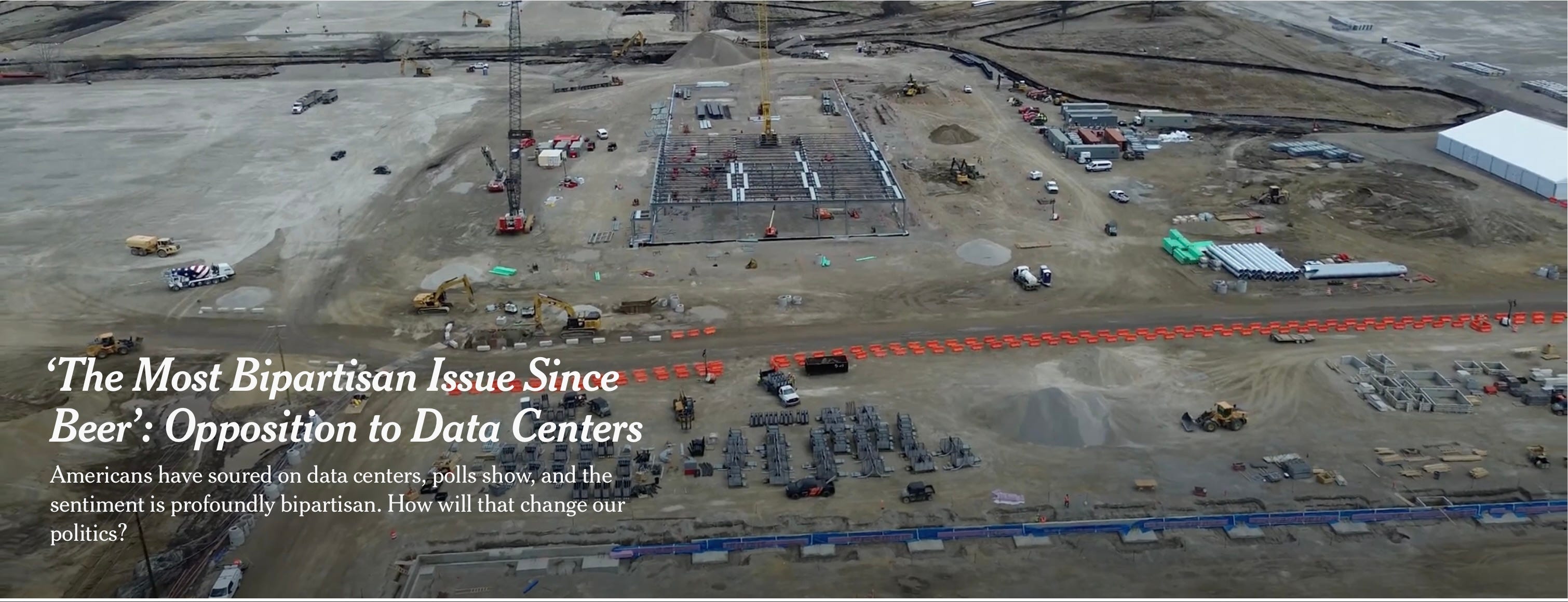
Please follow stories in Iowa Capital Dispatch, and read the Cheryl Tevis piece:
According to a story in the Dubuque County Herald:
Last week, the data center debate took off after community members and county officials learned that a developer recently approached landowners about selling farmland near Dubuque Regional Airport. Around 500 people, in person and online, filled a zoning commission meeting to oppose data center development, and over 7,800 people have signed a petition against data centers in Dubuque County.
Laura Belin is a part of the Iowa Writers’ Collaborative. She covers local policy issues extensively, and regularly features guest posts. Here is a statement from a member of the Cedar Rapids Board of Supervisors, Sami Sheetz.
Art Cullen wrote about Pope Leo and AI in the following editorial for his paper in Storm Lake: AI and NIMBY
Ed Tibbetts in Davenport is a dogged reporter covering transparency in local government. Subscribe to find out what’s going on in the Quad Cities.
Iowa Writers’ Collaborative

Help
If you are still with me, this is where I put a plea to subscribe to the news sources that bring you this information. And, at the risk of parroting one of the breathless fundraising emails your being inundated with by candidates for office today that start with:
My team and I had to make a difficult decision….blah, blah, blah.
Well, our team at the Iowa Writers’ Collaborative recently had to make a difficult decision: whether to continue producing the Iowa Down Ballot podcast through the summer months when the legislature is not in session.
Why? Quite simply, subscription revenue does not quite cover production costs.
That’s the reality facing independent journalism today. The work is valuable. The audience is growing. But quality reporting, thoughtful analysis, editing, production, and distribution all require resources.
To help ensure this important work continues, Richard and I will be opening our home on July 7 for a gathering featuring Laura Belin,
Dave Price, and Kathie Obradovich — three of Iowa’s most knowledgeable and trusted observers of state government and politics.
If you have not yet listened to Iowa Down Ballot, you are missing one of the smartest, most substantive, and often entertaining conversations about Iowa politics available anywhere. These three spend countless hours following legislative debates, committee meetings, campaigns, and policy decisions so the rest of us can better understand what is happening inside the Capitol.
We’ll share more details about the July 7 gathering soon.
In the meantime, if you value independent journalism and would like to receive an invitation to this event, please consider becoming a paid subscriber to Iowa Down Ballot here:

Here's a thought: communities taking $ in exchange for providing extreme amounts of water and energy, instead demand a piece of the action. These companies are making billions - why not demand a share? Stock? Profit sharing? Today they get a few million up front and live wirh the headaches (look at Palo). Demand a seat at the table with a sizeable share of stock in the company. Make them share the wealth - and decision making.
Every writer in this forum who addresses data centers provides excellent information. Iowa already has 100plus centers with more in the closet. I find it ironic that farmland is being cultivated for these centers, when our Legislature has made it difficult for farmland donation for prairie restoration or expanded public recreation. The QTS Center in SW Cedar Rapids is on 600 acres and is supposed to have a closed loop water system. With 60 percent of the US currently in drought conditions and our daytime and night temps increasing, we have trouble my friends.